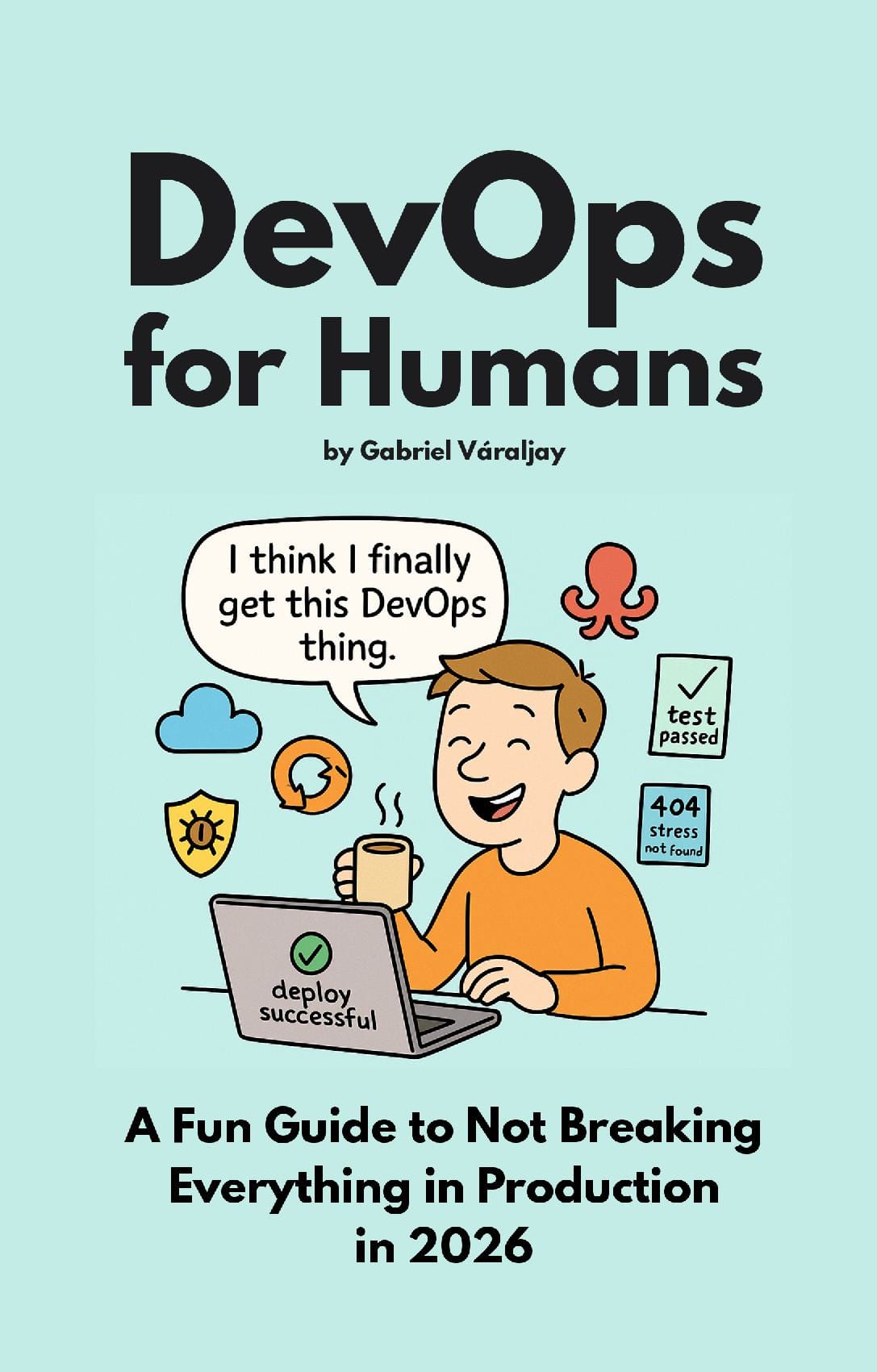
The DevOps Book That Doesn't Make You Feel Like an Idiot - Finally.
You've stared at a Kubernetes error message at 11pm and felt absolutely nothing except quiet dread. You've nodded confidently in a meeting about CI/CD pipelines while internally Googling what CI/CD stands for. You've watched a colleague push to production with alarming casualness and wondered whether you should say something or just quietly back up your work. DevOps for Humans: A Fun Guide to Not Breaking Everything in Production is the book that meets you exactly where you are - whether you're a developer who's avoided ops for years, a manager trying to understand what your team is actually building, or someone who just wants to ship software without summoning chaos. Practical, honest, and written with the kind of humour that only comes from someone who has personally broken things in production and lived to document it.
5 Myths That Make DevOps Feel Harder Than It Is
- Myth #1: "DevOps is only for senior engineers and infrastructure specialists." DevOps is a culture, a framework, and a set of practices - not a job title reserved for the initiated few. This book uses the CALMS framework to show that DevOps is fundamentally about how teams work together, and anyone on a software team can and should understand it.
- Myth #2: "I need to master Kubernetes before any of this makes sense." Kubernetes is a tool, not a prerequisite for understanding. This book explains containers, orchestration, and infrastructure from first principles - starting with the moving house analogy that finally makes it click - before introducing the tools that implement those ideas.
- Myth #3: "CI/CD just means automating deployments - it's mostly a DevOps team concern." CI/CD is the assembly line that determines whether your entire team ships features confidently or deploys in a cold sweat every Friday afternoon. Understanding it changes how developers write code, how managers plan releases, and how teams handle incidents when things go wrong.
- Myth #4: "Security is something you add at the end of the pipeline." The SolarWinds attack and Log4Shell didn't wait for anyone to finish shipping features. DevSecOps and shift-left security aren't buzzwords - they're the difference between catching a vulnerability in development and reading about your company on a breach disclosure website.
- Myth #5: "AI will replace DevOps engineers, so why bother learning this now?" AI is becoming a DevOps teammate, not a replacement. AIOps, self-healing infrastructure, and generative AI assistants make DevOps practitioners dramatically more powerful - but only if they understand what the AI is actually doing. This book covers the 2025 AI/DevOps landscape in full.
5 Headlines for the Humans Who Just Want to Ship Without Breaking Things
- If "It Works on My Machine" Has Ever Caused You Professional Embarrassment, This Book Is Your Redemption Arc
- How to Understand CI/CD, Containers, Kubernetes, IaC, and AIOps - Without Pretending You Already Know What Any of Those Mean
- The DevOps Guide That Skips the Condescension and Gets Straight to What You Need to Know to Actually Ship Software in 2025
- What If You Could Deploy to Production on a Friday Without That Specific Kind of Existential Terror? Here's the System That Makes It Possible.
- DevOps for Developers Who Code, Managers Who Approve, and Anyone Who Has Ever Nodded Confidently in a Meeting While Having Absolutely No Idea What Was Being Discussed
20 Reasons This Book Will Actually Get You Up to Speed
- Understand the CALMS framework - Culture, Automation, Lean, Measurement, Sharing - the GPS that tells you exactly what DevOps actually is and why it exists before you touch a single tool
- Learn the DevOps Infinity Loop and why it's the mental model that separates teams who ship confidently from teams who ship and immediately start hoping nothing breaks
- Discover how CI/CD works from first principles - the assembly line analogy that makes continuous integration and continuous deployment finally make intuitive sense
- Understand the DORA metrics - the four horsemen of DevOps success - and why they're the only numbers that actually tell you whether your engineering process is healthy or quietly on fire
- Get a clear, current 2025 CI/CD tools landscape covering the platforms teams are actually using, what differentiates them, and how to think about tool selection without drowning in vendor marketing
- Finally understand containers - what they are, why Docker started the revolution, and why the "moving house problem" is the only analogy you need to make it all click
- Learn Kubernetes from a human perspective - what it actually does, why orchestration matters at scale, and how to think about it before you ever run your first kubectl command
- Discover Infrastructure as Code and GitOps - why treating servers like software instead of unique snowflakes is the single change that eliminates the most painful categories of production disasters
- Understand Terraform and OpenTofu - the infrastructure languages the industry has converged on - and how AI-generated infrastructure code is changing what it means to provision environments in 2025
- Learn the four pillars of modern observability and why "everything is fine" is the most dangerous sentence in production - until your monitoring proves otherwise
- Discover Site Reliability Engineering - the Google playbook for running systems at scale - and how to connect SRE practices to the business OKRs that actually get leadership attention and budget
- Understand Platform Engineering - how Internal Developer Platforms create the "golden path" that lets developers spend time writing code instead of fighting with tooling, access, and environment setup
- Explore AIOps in depth - how AI is becoming a genuine DevOps teammate through intelligent monitoring, automated incident response, self-healing infrastructure, and generative AI assistants that write pipelines and spot anomalies
- Learn DevSecOps and supply chain security - SBOMs, shift-left testing, automated security scanning, and the regulatory requirements that are making security a first-class engineering concern whether teams want it to be or not
- Understand multi-cloud strategy - the real trade-offs between AWS, Azure, and GCP, and how organisations think about not putting all their eggs in one cloud provider's basket
- Get practical alerting guidance - how to build monitoring that actually tells you when something is wrong without creating alert fatigue that trains everyone to ignore the alarms
- Discover MLOps - how teams are treating machine learning models as first-class citizens in their deployment pipelines, and why this matters even for teams not primarily building AI products
- Learn the compliance and governance automation approaches that let regulated industries ship fast without sacrificing the audit trails and controls their regulators require
- Understand the organisational and cultural side of DevOps - why the tools are the easy part, and how the human dynamics of Platform teams, Dev/Ops relationships, and blameless post-mortems determine whether any of it actually works
- Read the DevOps book written by someone who has been confused by all of this themselves - and who has distilled years of hard-won, occasionally painful experience into a guide that respects your intelligence without assuming your prior knowledge
5 Reasons People Think This Book Isn't for Them
- "I'm a developer, not a DevOps engineer - this isn't really my domain." The line between developer and DevOps practitioner has been dissolving for a decade. If you write code that runs in production, understanding how it gets there and how it behaves when it arrives is now part of the job. This book makes that knowledge accessible without requiring a career change.
- "I'm a manager - this is too technical for what I need." This book was written specifically to be readable by non-engineers who need to understand what their teams are doing, why it matters, and how to ask intelligent questions in the meetings where these decisions get made. The technical depth is there for those who want it - but it's never a barrier.
- "I've tried to learn DevOps before and got lost in the jargon." That's the exact problem this book exists to solve. Every concept is introduced with a plain-English analogy before the technical implementation - because the ideas behind DevOps are straightforward, and the jargon is what makes them artificially hard.
- "This will be outdated in six months - the tools change too fast." Tools change. Principles don't. This book teaches you how to think about CI/CD, observability, security, and infrastructure in ways that survive tool generations - while also giving you the current 2025 landscape so you're not working from a three-year-old mental model.
- "I need a certification course, not a book." Certification courses teach you what to click. This book teaches you why any of it matters - the mental models, the reasoning, and the culture that make DevOps practitioners genuinely effective rather than just credentialled. Both have their place; this one makes the other one make more sense.