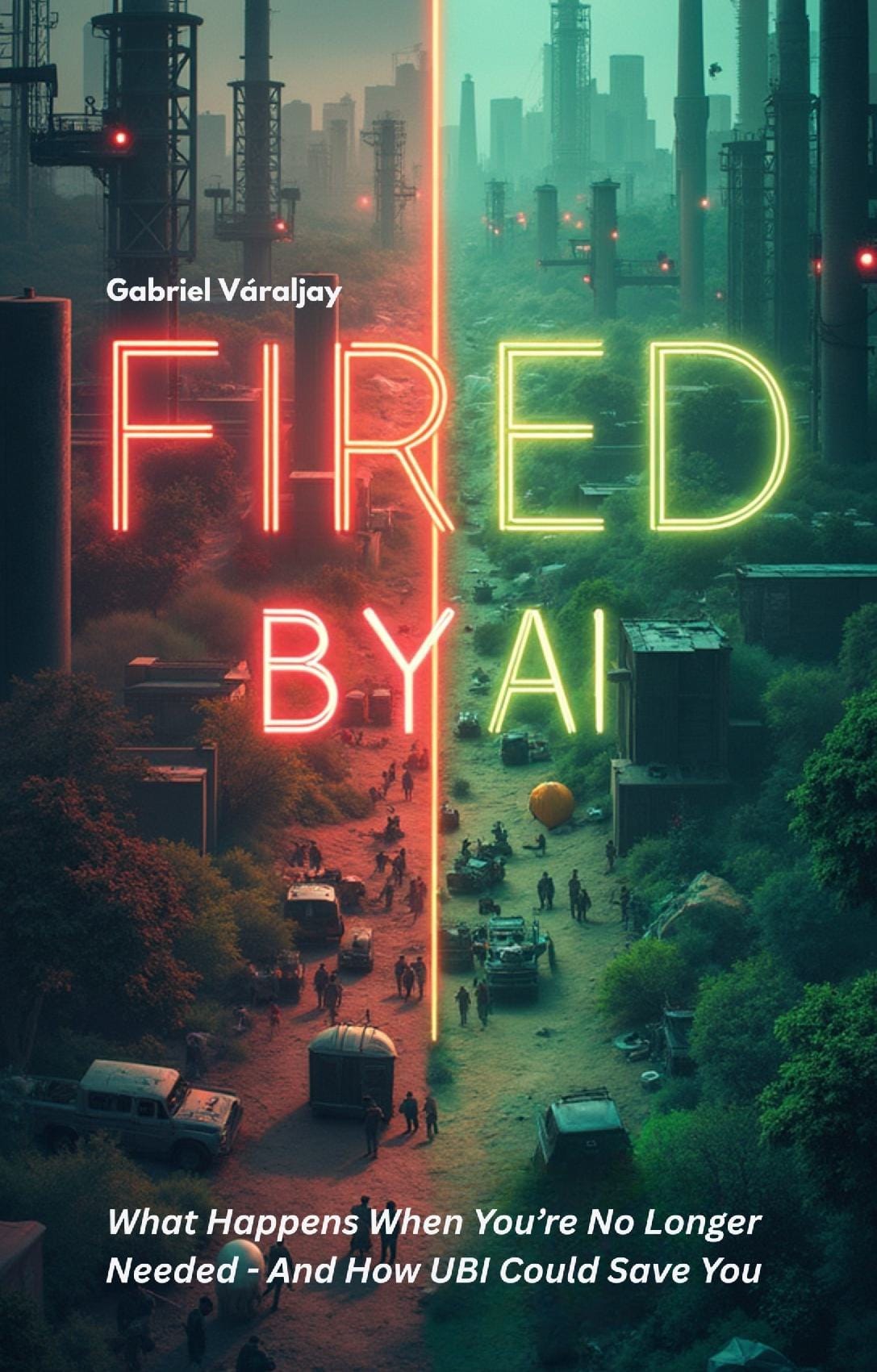
30% of All Jobs Could Be Gone by 2030. Is Yours on the List?
Picture this: you wake up tomorrow and your job no longer exists. Not because you were fired. Not because the company went bankrupt. Because a machine learned to do what you do - better, faster, and for a fraction of the cost. McKinsey estimates 30% of all jobs could be automated by 2030. The Oxford study puts the US risk at 47%. These aren't abstract statistics. They represent millions of real people, real families, and real communities facing an economic earthquake with no safety net in sight. Fired by AI is the book that tells you exactly what's coming, when it's coming, and - most importantly - the one policy solution that could transform the greatest economic crisis in human history into the greatest opportunity humanity has ever known.
5 Myths About AI, Automation, and the Future of Work
- Myth #1: "AI will create more jobs than it destroys - just like every previous technology revolution." Previous revolutions unfolded over generations. AI is replacing entire departments in months. GPT-4 went from impressive chatbot to passing the bar exam in under a year. The speed of this disruption is categorically different - and the old reassurances no longer hold.
- Myth #2: "Just get more education or learn to code - you'll be fine." AI is already writing better code than most programmers. It's passing medical licensing exams, drafting legal briefs, and generating financial analysis. "Upskill your way out" was good advice in 2015. In 2025, it's a platitude that leaves people dangerously unprepared.
- Myth #3: "Universal Basic Income is a utopian fantasy - we could never afford it." This book presents a concrete, VAT-based financing strategy that shows not only how UBI can be funded, but why it may be the most fiscally responsible response to the automation wave - with real pilot program data from multiple countries to back it up.
- Myth #4: "UBI is just welfare with a rebrand - it will make people lazy and dependent." The field data says otherwise. Every major UBI pilot studied shows improvements in mental health, entrepreneurship, education outcomes, and community engagement. This book walks through the evidence - including the critics' strongest arguments and exactly why they don't hold up.
- Myth #5: "This won't affect my job - AI is only replacing low-skill work." White-collar professionals are among the most exposed. Lawyers, accountants, radiologists, journalists, financial analysts, and software developers are all seeing AI encroach on their core work. No industry is immune, and this book shows you the timeline of exactly when each sector faces peak disruption.
5 Headlines for the Moment We Can No Longer Ignore
- If You Think AI Automation Is Someone Else's Problem, You Have Approximately 5 Years Before It Becomes Yours - Here's What to Do Before Then
- 47% of US Jobs at High Risk of Automation - Without UBI, What Happens to the Other Half of the Economy When They Stop Getting Paid?
- The Book That Explains Why "Just Learn to Code" Is Dead Advice - and What the Real Answer to the AI Jobs Crisis Actually Is
- What If the Biggest Economic Disruption in Human History Could Also Be the Greatest Liberation from Meaningless Work - If We Handle It Right?
- Universal Basic Income Isn't Charity, Isn't Welfare, and Isn't a Fantasy - Here's the Data, the Financing Plan, and the Timeline That Proves It's Inevitable
20 Reasons This Book Will Change How You See the Economy, AI, and Your Own Future
- Understand the full scale of the coming automation wave - with specific data on which jobs, which industries, and which timelines face the highest disruption risk between now and 2035
- Discover why this technological revolution is fundamentally different from every previous one - and why the historical reassurance that "technology always creates more jobs" may not apply this time
- Get a detailed technology timeline showing when AI and automation are projected to reach critical penetration in each major sector - so you can see exactly where your industry sits on the disruption curve
- Learn what Universal Basic Income actually is - and what it isn't - with a clear, jargon-free explanation that cuts through the political noise from both sides
- Explore the real-world UBI pilot programs from Finland, Kenya, Stockton, and beyond - what the data actually showed about work, health, creativity, and human behaviour when the floor was guaranteed
- Understand the VAT-based financing strategy that makes UBI economically viable - the detailed funding model that answers the most common objection before you even finish asking it
- Discover why UBI is not welfare, not charity, and not a handout - but an investment in human potential at precisely the moment when technology is making most human labour economically obsolete
- Learn why every alternative to UBI - job retraining, education subsidies, expanded welfare, work-sharing - fails to address the fundamental scale and speed of what's coming
- Explore the strongest arguments against UBI - inflation, work disincentives, cost, political feasibility - with the rigorous counterarguments and data that answer each one directly
- Find out what a post-scarcity, UBI-supported economy could actually look like in practice - for individuals, families, communities, and the broader culture of work and meaning
- Understand the political path forward - which coalitions, which policy levers, and which implementation strategies give UBI its best realistic chance of becoming law within the decade
- Discover the ENVIENTA connection - how the author's decade-long journey through cooperative economics, open-source manufacturing, and social entrepreneurship shaped the ideas in this book
- Learn why the automation tsunami is already here - not coming - and why the gap between "AI can't do that" and "AI just replaced an entire department" is now measured in months, not years
- Understand what exponential technological change actually means for economic policy - and why governments built for linear change are structurally unprepared for what's already unfolding
- Find out which demographic groups face the earliest and most severe disruption - and why the policy response needs to move faster than any government has moved on economic reform in living memory
- Explore the psychological and social dimensions of mass job displacement - what happens to identity, community, and purpose when work disappears, and how UBI addresses more than just the financial gap
- Discover why the window for an orderly transition is narrow - and what the difference looks like between a society that implements UBI proactively versus one that scrambles to respond after the crisis has already hit
- Learn how smart taxation of AI-generated productivity - the economic value created by machines replacing human workers - can fund the very safety net those displaced workers need
- Get the implementation roadmap: the phases, the political prerequisites, the economic triggers, and the international examples that show exactly how a society moves from here to there
- Read the book that treats you as an intelligent adult who can handle the full complexity of the most important economic question of the next decade - and gives you everything you need to form your own informed position
5 Reasons People Think a Book About UBI Won't Matter to Them
- "I'm not at risk - my job requires human judgment and creativity." So did writing, illustration, legal research, financial analysis, and medical diagnosis - until recently. The book includes a sector-by-sector disruption timeline that may challenge your confidence in ways worth knowing about now rather than later.
- "UBI is too politically toxic to ever actually happen." A decade ago, same-sex marriage, legalised cannabis, and $15 minimum wages were considered politically impossible. Political reality moves fast when economic pressure becomes undeniable. This book maps the realistic path from fringe idea to policy necessity.
- "This is just another doom-and-gloom AI book." The preface announces it clearly: the automation wave could be the greatest opportunity humanity has ever known - if we handle it right. This book is ultimately about liberation, not catastrophe, and the data from UBI pilots consistently supports that framing.
- "I'm close to retirement - this won't affect me." It will affect your children, your grandchildren, the pension systems you depend on, and the tax base that funds every public service you use. The economic disruption of mass automation touches every generation simultaneously.
- "The government will figure it out." Governments are currently operating with 20th-century economic frameworks while facing a 21st-century disruption accelerating faster than any institution has historically been able to respond. This book exists precisely because waiting for governments to figure it out without public pressure and understanding is not a viable strategy.