What If Everything You're Experiencing Right Now Isn't Real?
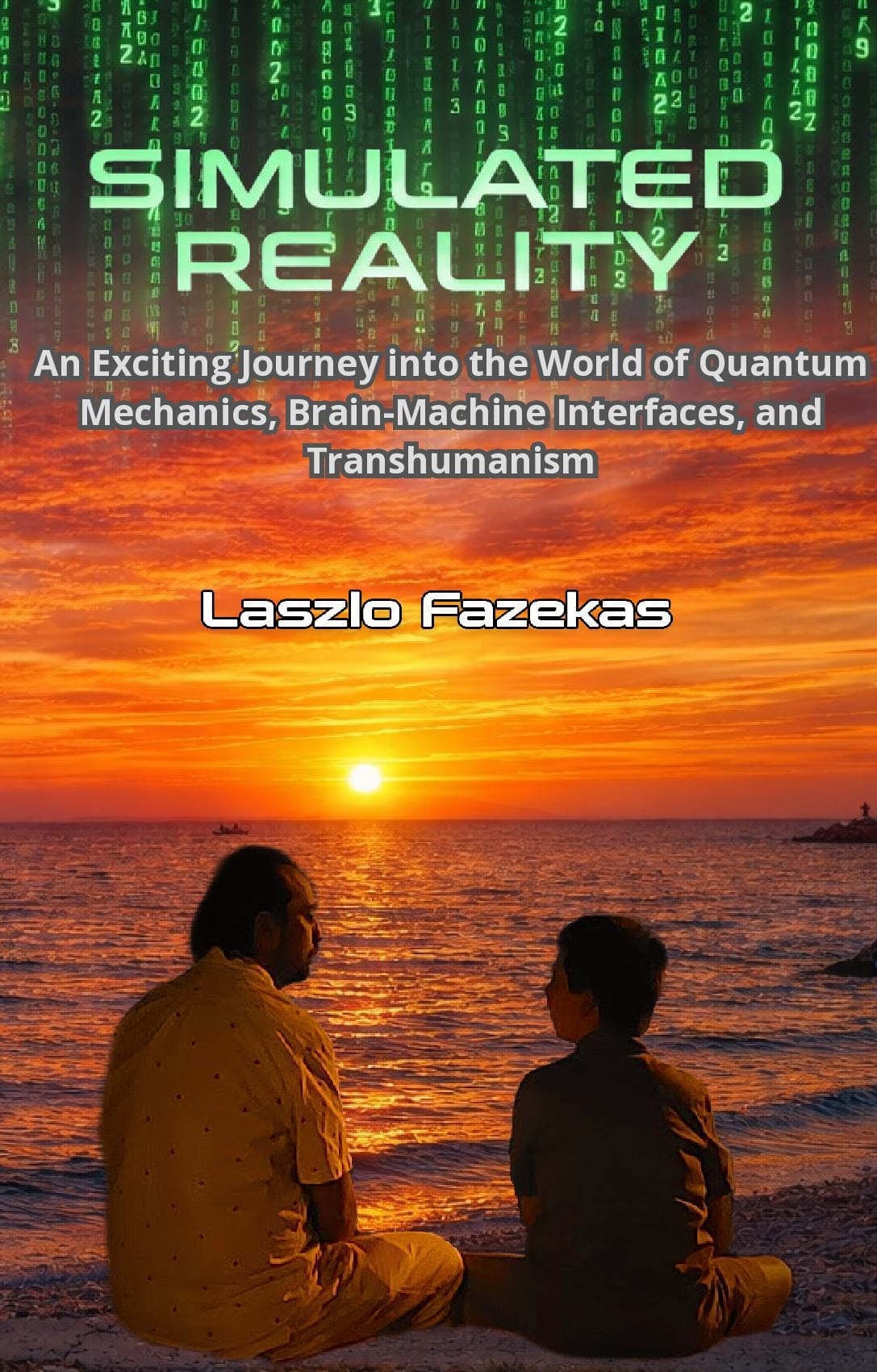
You've had the thought. Maybe as a child, staring at the ceiling at night. Maybe in the middle of an ordinary Tuesday, struck suddenly by the sense that something about all of this is too seamless, too constructed, too strange to be entirely what it appears. Almost everyone has wondered it at least once: What if this isn't real? Most people let the thought pass. Laszlo Fazekas held onto it for thirty years - and then wrote the book that takes it completely seriously. Simulated Reality is an exhilarating journey through quantum mechanics, brain-machine interfaces, and transhumanism that asks the question humanity has circled since Plato's cave - and follows it all the way to its most extraordinary implications for physics, technology, consciousness, and the future of the human species.
5 Myths About the Simulation Hypothesis - and Why the Science Is More Surprising Than the Fiction
- Myth #1: "The simulation hypothesis is just science fiction." Quantum mechanics - the most rigorously tested theory in the history of science - already describes a reality so bizarre that the simulation hypothesis is not even the strangest interpretation on the table. This book shows you what modern physics actually says about the nature of reality, and why some of the world's leading physicists take this question very seriously indeed.
- Myth #2: "This is abstract philosophy with no practical implications." Brain-computer interfaces, Neuralink, fully immersive virtual reality, and nanobot-based neural engineering are not thought experiments - they are active research programs with billions of dollars behind them. Part Two of this book is a practical examination of how we might build a simulation of our own, and why doing so could be the most important project in human history.
- Myth #3: "Transhumanism is fringe thinking." The convergence of AI, nanotechnology, brain-machine interfaces, and genetic engineering is already producing capabilities that would have seemed impossible a generation ago. This book traces the serious scientific and philosophical case for human enhancement, digital consciousness, and the possibility that Homo sapiens may not be the final form of human intelligence.
- Myth #4: "Quantum mechanics is too technical for non-scientists to understand." The author spent thirty years waiting for the right way to explain these ideas to a general audience - and the result is a book that takes quantum superposition, entanglement, and the measurement problem seriously without losing the reader in mathematics. The ideas are strange enough on their own terms; they don't need to be made harder than they are.
- Myth #5: "Even if we're in a simulation, there's nothing we can do about it." This book disagrees. From the Free Energy Principle to Boltzmann Brains to the theoretical mechanics of escaping a simulated reality - the final chapter of Part One asks the question nobody else is asking: not just whether we're in a simulation, but whether we could ever get out.
5 Headlines for the Question That Never Lets Go
- If You've Ever Wondered Whether Any of This Is Real, This Book Will Take That Question Further Than You Expected - and the Physics Makes It Worse
- From Plato's Cave to Neuralink: The Complete Scientific and Philosophical Case for Simulated Reality - Written for Curious Minds, Not Physics PhDs
- What Quantum Mechanics, Brain-Machine Interfaces, and Transhumanism Have to Say About the Nature of Reality - and What Happens to Humanity If They're Right
- The Book That Follows the Simulation Hypothesis All the Way to Its Most Extraordinary Conclusion: What If Building Our Own Simulation Is the Only Path to a Sustainable Future?
- How Einstein's Relativity, Quantum Mechanics, and the Singularity Converge on a Single Terrifying and Exhilarating Possibility - That We Are Already Living Inside Someone Else's Universe
20 Reasons This Journey Will Change How You See Everything
- Discover why the simulation hypothesis is not fringe speculation but a serious philosophical and scientific proposition - and why it emerges naturally from the most rigorous theories in modern physics
- Follow the argument from Plato's Allegory of the Cave through Descartes' brain-in-a-vat thought experiment to Nick Bostrom's trilemma - the philosophical lineage of an idea that has been building for 2,500 years
- Understand Einstein's Theory of Relativity in terms that actually make sense - and see why its redefinition of space and time was the first crack in our common-sense picture of reality
- Explore quantum mechanics and its most bizarre implications: superposition, entanglement, the measurement problem, and the many-worlds interpretation - explained clearly for non-scientists without sacrificing the genuine strangeness of what the physics actually says
- Discover what modern physics has to say about the nature of reality - and why several of its most serious interpretations are stranger than any simulation hypothesis
- Learn the Free Energy Principle and its relationship to the ultimate simulation - the theoretical framework that connects how brains model reality with how a simulated universe might be constructed
- Explore Boltzmann Brains and the self-observing universe - the deeply unsettling possibility that arises when you take thermodynamics and cosmology seriously in combination
- Find out what it would theoretically mean to escape from a simulation - the most provocative chapter in the book, and the one that follows the hypothesis further than almost any other treatment of the subject
- Enter Part Two: How to Build a Simulation - the engineering case for why creating our own simulated reality could be not just possible but the most viable path toward a sustainable future for humanity
- Discover the evolution of brain-machine interfaces - from the earliest neural recording experiments to Neuralink and the Cybercortex - and understand how close we actually are to fully immersive virtual reality built directly into human consciousness
- Learn how scientists are reading the mind with light - the photonics and optogenetics research that is making non-invasive brain-computer interfaces a practical engineering problem rather than a theoretical one
- Understand the current state of brain engineering - what we can already do, what the next decade will bring, and what the convergence of neuroscience and AI means for the boundary between biological and digital consciousness
- Enter Part Three: Transhumanism - the rigorous, science-grounded case for human enhancement, radical life extension, and the possibility that our species is approaching the most profound transformation in its history
- Explore the Singularity - the moment when artificial intelligence surpasses human intelligence - and what the first moment of that transition might actually look like from the inside
- Discover the serious philosophical and scientific case for forms of immortality - from biological enhancement to mind uploading to digital consciousness - and what each path implies for personal identity, meaning, and the nature of the self
- Learn about nanobot swarms and intelligent matter - the convergence of nanotechnology and AI that could make it possible to engineer intelligence at the molecular level
- Explore what "After the Flesh" might actually mean - the final evolution of humanity from Homo sapiens to what Yuval Noah Harari calls Homo deus, living inside digital universes of our own creation
- Experience the science fiction short stories that open each section - original narratives written to spark curiosity and prime the imagination for the science that follows, because the ideas in this book deserve an entrance worthy of their strangeness
- Read a book thirty years in the making - written by someone who has been genuinely obsessed with this question since childhood, and who waited until both the ideas and the technology were ready to do the subject justice
- Discover why the timing of this book is not accidental - the decades between the author's childhood question and this first book were needed not just for the ideas to mature, but for the technology to catch up to the questions it was always going to raise
5 Reasons People Think This Book Isn't for Them
- "I'm not a scientist - quantum mechanics will go over my head." This book was written specifically for curious non-scientists. The author spent decades finding the right way to explain these ideas to a general audience, and the approach works: the concepts are introduced through thought experiments, analogies, and science fiction before the physics and philosophy deepen them. No equations required.
- "I've seen The Matrix - I already know the simulation hypothesis." The Matrix is Plato's cave retold with modern technology. This book starts where The Matrix ends and goes somewhere it never imagined: into the actual physics of quantum mechanics, the real engineering of brain-computer interfaces, and the genuine scientific debate about whether our reality has the structure of a simulation.
- "Transhumanism and AI immortality feel too speculative to take seriously." The book makes a clear distinction between serious scientific extrapolation and science fiction. Every claim is grounded in current research, existing technology trajectories, and the work of scientists and philosophers who are actively pursuing these questions. The speculation is earned, not lazy.
- "Philosophy of reality sounds dry and academic." Each of the book's three sections opens with an original science fiction story. The philosophical arguments are built on thought experiments, historical narratives, and moments of genuine wonder. This is one of the most intellectually adventurous books you will read - and it is written to feel that way from the first page.
- "I prefer books that stay grounded in the present, not the distant future." Part One deals entirely with existing physics and how it already challenges our picture of reality. Part Two examines technologies - Neuralink, brain-computer interfaces, VR - that are being built right now. The future in this book is already arriving, and understanding it starts with the physics and neuroscience of the present.